How the Study of Play Came to Include Casinos
The history of studying play traces how games became a subject in their own right, helping you place casino culture within a wider academic conversation.
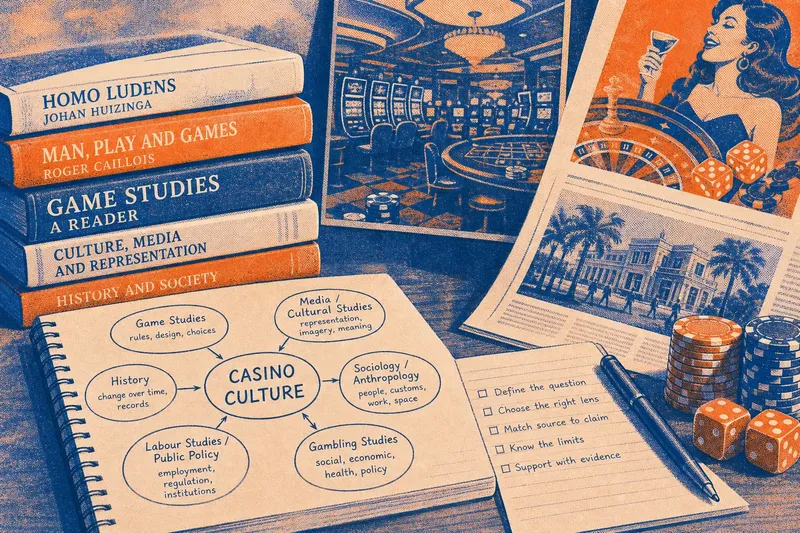
The common mistake in studying play is to assume that games became an academic subject only with digital entertainment. The history of studying play is older and less tidy: writers have approached games through childhood, culture, ritual and leisure, while later scholarship made games and play more explicit objects of inquiry. That distinction helps explain how casino culture can be studied without treating every game as the same activity.
What did earlier writers ask about play?
Play appeared in writing about education, childhood, social conduct and ritual long before game studies took shape as a recognisable area of academic work. In those discussions, play often helped address a broader question rather than serving as the central object. This is a cautious way to describe a scattered history, not a claim that one unified discipline steadily developed across periods and places.
Two influential twentieth-century landmarks are Johan Huizinga’s Homo Ludens and Roger Caillois’s Man, Play and Games. Huizinga considered the place of play in culture; Caillois set out categories associated with competition, chance, imitation and vertigo. They offer distinct ways to frame questions about play, but neither should be treated as a complete history or an explanation that fits every game.
Rather than claiming a single turning point, it is more accurate to describe a widening set of questions. Scholars asked what distinguishes play, how rules shape an activity and what play means in a particular setting. A chess club, playground and casino may all involve rules and choices, yet their institutions and consequences are not interchangeable.
How did game studies broaden its questions?
Academic work on games has drawn on established approaches such as literary study, history, anthropology, design and media analysis. Some work examines rules and systems; other work attends to stories, images, players or the circumstances in which games are made and used. These are different emphases, not a simple sequence in which one approach displaced all the others.
Digital games made software, interfaces and player communities prominent topics, but they did not make older forms of play equivalent to computer games. Board games, sports, card games and casino games have different materials, conventions and histories. The useful point is methodological: a subject can invite several kinds of analysis without becoming one uniform object.
For casino culture, that means asking whether the subject is a game’s design, a film’s imagery, an institution’s public representation or a documented local history. Each question calls for evidence suited to it. This account describes broad intellectual landmarks rather than claiming to provide a fully sourced chronology of the field.
Which academic lens suits casino culture?
Begin with the question, then select an approach that can address it. Casino culture is better treated as a subject approached through several disciplines than as a single method with settled boundaries.
- Game studies or design: Check whether the question concerns rules, choices or how a game is presented. If it does, analyse those features; if it concerns an institution’s past, use historical records instead.
- Media or cultural studies: Check whether the material is a film, advertisement, novel or news report. If the claim concerns imagery and meaning, analyse the representation; if it concerns actual practice, seek evidence about that practice instead.
- History: Check whether the question concerns change over time and whether relevant records are available. If records document the change, use them to support a bounded account; if they do not, narrow the claim to what the material can show.
- Sociology or anthropology: Check whether the question concerns social relations, customs, work or the use of a space. If the evidence addresses those matters, examine them; if it consists only of fictional scenes, analyse representation instead.
- Labour studies or public policy: Check whether the focus is employment, formal rules or institutional decisions. If it is, consult suitable records and scholarship; if the question concerns personal experience those sources do not address, seek appropriate evidence rather than infer it.
- Gambling studies: Check whether the question concerns gambling’s social, economic, health or policy dimensions. If it does, consult relevant scholarship and public sources; if you are seeking personal gambling advice, this academic approach is not a substitute for qualified help.
These fields are like drawers in a desk: labels help organise material, but the question decides which drawer is useful. A project can combine approaches if it explains what each one contributes.
What can different sources support?
Local newspapers, official records, company documents and archival photographs may help a historian reconstruct aspects of a casino’s past. Films and advertisements can support analysis of representation. Legislation and public documents can inform work on formal policy. Interviews and observation require appropriate ethical practice; neither should be replaced by assumptions drawn from fictional portrayals.
Limits matter as much as subject matter. A film can show how a casino is represented, but cannot by itself establish how a real workplace operates. A legal document can describe formal rules without showing how people interpret them. Keep each claim within the reach of its source.
Say you are preparing a seminar paper on casino portrayals, starting with one film scene, one advertisement and one newspaper feature. You compare how the three materials present luck, skill and social status. The resulting argument is about representation; it does not establish how visitors behave or how a casino operates.
Which questions help place casino culture in the history of play?
Is game studies the same as gambling studies?
No. Game studies examines games as designed and cultural forms, while gambling studies focuses more directly on gambling’s social, economic, health or policy dimensions. A project can connect them by asking how a casino game’s design relates to the setting in which it is played.
Can casino culture be studied without examining gambling behaviour?
Yes. A project can focus on architecture, employment, local history, public regulation or film portrayals. Its claims should stay within that chosen focus and the evidence gathered.
Does the history of studying play explain every kind of game?
No. Broad theories can help frame questions, but a playground, sport and casino have different rules, institutions and consequences. A careful account makes those differences visible rather than forcing them into one explanation.
What should a beginner read first?
Begin with an introduction to play or game studies, then find scholarship on the specific subject, such as casino history or media portrayals. That pairing supplies general vocabulary while keeping the next question anchored in a particular topic.
How can a seminar make the history concrete?
Imagine a seminar at Vinh University asking how academic study of play broadened to include casino culture. The starting materials are Huizinga’s account of play and culture, Caillois’s categories, and one contemporary film scene featuring a casino. First, students identify the claims about play in each book; next, they note how the scene represents the casino; then, they separate claims about the film from claims about real institutions. The answer they can support is a comparison between broad theories of play and a specific media portrayal, not a history of casino practice.
For a paper on this subject, the phrase “history of studying play” is most useful when it points to a question rather than implying a settled, continuous narrative. The record is better approached through named works, clearly bounded claims and sources that match the subject under discussion.