Read Casino Culture in Vinh Without Visiting a Casino
Read casino culture in Vinh from home with an accessible story or film scene, then compare its tone and framing with a university page through focused notes.
The common mistake in a home reading session about casino culture in Vinh is letting a dramatic scene stand in for local knowledge. A story or film can show how its creator frames gambling; it cannot, by itself, tell you how gambling works in Vinh. Keep the session focused on the work in front of you, and choose a source you can access lawfully from home.
Pair that work with a public page from Trường Đại học Vinh only if you have a genuine reason to read both. The comparison can illuminate differences in tone, purpose and audience without implying that the university and casino activity are connected.
What makes a useful subject for a home reading session?
Choose a casino-themed short story, film scene, published review or authorised cultural excerpt. Use a library catalogue, publisher or legitimate streaming platform to check access before you settle on a text. No venue visit is necessary.
Select a passage or scene with details you can return to: perhaps dialogue about chance, a character facing a decision or a description of a gaming room. Note the title, creator and publisher or platform. Record a date if one is provided; if it is absent, leave it unknown.
If you want to bring in Trường Đại học Vinh, choose a public page that serves a distinct reading purpose, such as an institutional history or description of academic life. Read it for what it says about its stated subject, not as a substitute for information about gambling.
How can you keep observation separate from interpretation?
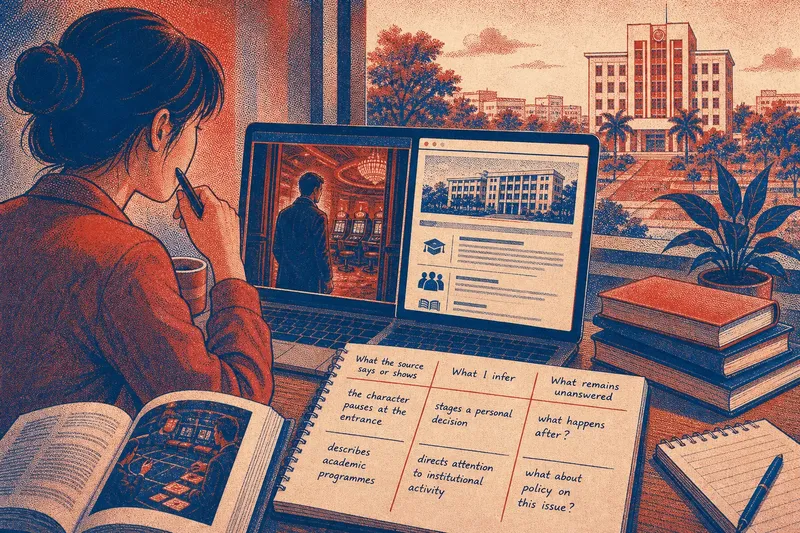
Open the sources in separate browser tabs, or set printed copies side by side. Divide a sheet into three columns: What the source says or shows, What I infer and What remains unanswered. Like sorting letters into separate folders, this keeps the source’s words apart from the meaning you make of them.
In the first column, quote a short phrase or describe a visible detail accurately. In the second, explain what it suggests to you. In the third, write a question the source cannot settle. For a film, note the scene’s place in the story; for a written page, record the section heading or surrounding paragraph.
Say you have a public university profile and an authorised short story in which a fictional character hesitates before entering a gaming room. You write “describes academic programmes” beside the profile and “the character pauses at the entrance” beside the story. You infer that one directs attention to institutional activity while the other stages a personal decision; the observable result is a comparison of emphasis, not an answer about policy or local practice.
What should you check before comparing the sources?
- Access: If a library, publisher or authorised platform provides the work, use that version; if access depends on a venue visit or an unauthorised copy, choose another work.
- Publisher: If the university page is published by Trường Đại học Vinh, describe it as institutional information; if another organisation published it, identify it as external commentary.
- Date and context: If the page gives a date or explains its context, record that alongside your notes; if neither appears, mark the timing or context as unclear rather than guessing.
- Exact detail: If you can locate the words, image or scene that supports a point, record it as an observation; if you cannot, treat the point as an interpretation or leave it out.
- Relevance to Vinh: If a source directly addresses Vinh, describe its claim and who published it; if it does not, leave local questions open and seek a source that does.
- Fictional character: If your point concerns the work’s storytelling or tone, discuss it as fiction; if it depends on the character representing real people, drop that inference or find direct evidence.
How can you compare tone and purpose without forcing a link?
Choose a feature that is genuinely present in both sources, such as intended audience, tone or treatment of responsibility. A university page may foreground academic activity, while a story makes uncertainty part of a character’s decision. That contrast describes two texts; it does not establish a shared event, policy or local practice.
It is also reasonable to decide that the sources do not make a useful pair. If one has no meaningful point of comparison with the other, read them separately rather than inventing a connection. The question is not whether both can be made to say the same thing, but what each one actually asks its reader to notice.
What questions do readers ask about casino culture in Vinh?
Can I watch a casino scene without visiting a casino?
Yes, if the film or other audiovisual work is available through a legitimate home-access source. Discuss its dialogue, setting and editing as choices within the work, not as a record of a particular venue.
What can a Trường Đại học Vinh profile tell me?
It can show what the institution states on that page about its history, programmes or public role. For questions beyond that scope, look for a source that addresses them directly.
Does a casino-themed story describe gambling in Vinh?
Not on its own. A story shows how its creator uses gambling as a subject or setting; claims about activity in Vinh need sources specifically about the place.
Where should I look for information about university policy?
Seek an official policy, announcement or other institutional document that directly covers the issue. If you cannot find one, leave the question open rather than drawing an answer from a story or an unrelated profile.
How can you leave the session with useful notes?
Write one observation from each source and a comparison that stays within those observations. Then name one question you could not answer and the kind of source that might address it, such as an official document for a policy question or a reliable local account for a claim about Vinh.
Keep the titles and publication details with your notes. When you return to casino culture in Vinh, that record will help you distinguish what a source actually presents from the interpretation it prompted, and keep the reading grounded in its real subject: how a particular work shapes attention.